執位(permutation)係一類代數類型。佢係由一堆函數組成,佢哋嘅性質就係將個集/群入面嘅嘢調亂。情形就好似一班學生排排坐好,之後將佢哋嘅位執過。
呢個概念喺19世紀中已經有數學家討論,直到1850年左右數學家Cayley用抽象群嘅概念討論執位。
執位係一個由集 A {\displaystyle A} 打返去集 A {\displaystyle A} 嘅可逆函數,即係 ϕ : A → A {\displaystyle \phi :A\to A} 。
執位群(Permutation Group)係一個群,入面全部都係 A {\displaystyle A} 嘅執位。二元運算就係組合函數 ∘ {\displaystyle \circ } 。
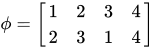
同微積分唔同嘅就係喺代數世界入面好少用一條公式嚟代表一個函數。例如: ϕ {\displaystyle \phi } 係 { 1 , 2 , 3 , 4 } {\displaystyle \{1,2,3,4\}} 嘅換位。可以定義, ϕ ( 1 ) = 1 , ϕ ( 2 ) = 4 , ϕ ( 3 ) = 2 , ϕ ( 4 ) = 3 {\displaystyle \phi (1)=1,\phi (2)=4,\phi (3)=2,\phi (4)=3}
我哋可以用一個矩陣嚟代表 ϕ {\displaystyle \phi } : ϕ = [ 1 2 3 4 ϕ ( 1 ) ϕ ( 2 ) ϕ ( 3 ) ϕ ( 4 ) ] = [ 1 2 3 4 1 4 2 3 ] {\displaystyle \phi ={\begin{bmatrix}1&2&3&4\\\phi (1)&\phi (2)&\phi (3)&\phi (4)\end{bmatrix}}={\begin{bmatrix}1&2&3&4\\1&4&2&3\end{bmatrix}}} 如果 { 1 , 2 , 3 , 4 , 5 } {\displaystyle \{1,2,3,4,5\}} 有兩個執位 ϕ = [ 1 2 3 4 5 2 4 3 5 1 ] ; σ = [ 1 2 3 4 5 5 4 1 2 3 ] {\displaystyle \phi ={\begin{bmatrix}1&2&3&4&5\\2&4&3&5&1\\\end{bmatrix}};\sigma ={\begin{bmatrix}1&2&3&4&5\\5&4&1&2&3\\\end{bmatrix}}} 咁 σ ϕ = [ 1 2 3 4 5 2 4 3 5 1 ] [ 1 2 3 4 5 5 4 1 2 3 ] = [ 1 2 3 4 5 1 5 2 4 3 ] {\displaystyle \sigma \phi ={\begin{bmatrix}1&2&3&4&5\\2&4&3&5&1\\\end{bmatrix}}{\begin{bmatrix}1&2&3&4&5\\5&4&1&2&3\\\end{bmatrix}}={\begin{bmatrix}1&2&3&4&5\\1&5&2&4&3\\\end{bmatrix}}} σ ϕ {\displaystyle \sigma \phi } 嘅意思係 σ ∘ ϕ {\displaystyle \sigma \circ \phi } ,先做 ϕ {\displaystyle \phi } 再做 σ {\displaystyle \sigma } 。 所以, σ ϕ ( 1 ) = σ ( ϕ ( 1 ) ) = σ ( 5 ) = 1 {\displaystyle \sigma \phi (1)=\sigma (\phi (1))=\sigma (5)=1} 。
三邊對稱群 S 3 {\displaystyle S_{3}} ,係所有嗚 { 1 , 2 , 3 } {\displaystyle \{1,2,3\}} 自己入面嘅單對單函數。咁 S 3 {\displaystyle S_{3}} 係一個執位群,佢有六嚿嘢。
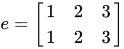
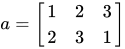
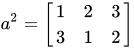
e = [ 1 2 3 1 2 3 ] {\displaystyle e={\begin{bmatrix}1&2&3\\1&2&3\\\end{bmatrix}}} , a = [ 1 2 3 2 3 1 ] {\displaystyle a={\begin{bmatrix}1&2&3\\2&3&1\\\end{bmatrix}}} , a 2 = [ 1 2 3 3 1 2 ] {\displaystyle a^{2}={\begin{bmatrix}1&2&3\\3&1&2\\\end{bmatrix}}} ,
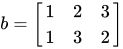
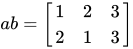
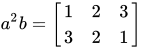
b = [ 1 2 3 1 3 2 ] {\displaystyle b={\begin{bmatrix}1&2&3\\1&3&2\\\end{bmatrix}}} , a b = [ 1 2 3 2 1 3 ] {\displaystyle ab={\begin{bmatrix}1&2&3\\2&1&3\\\end{bmatrix}}} , a 2 b = [ 1 2 3 3 2 1 ] {\displaystyle a^{2}b={\begin{bmatrix}1&2&3\\3&2&1\\\end{bmatrix}}} 。
計下:
a b = [ 1 2 3 2 3 1 ] [ 1 2 3 1 3 2 ] = [ 1 2 3 2 1 3 ] {\displaystyle ab={\begin{bmatrix}1&2&3\\2&3&1\\\end{bmatrix}}{\begin{bmatrix}1&2&3\\1&3&2\\\end{bmatrix}}={\begin{bmatrix}1&2&3\\2&1&3\\\end{bmatrix}}}
b a = [ 1 2 3 1 3 2 ] [ 1 2 3 2 3 1 ] = [ 1 2 3 1 3 2 ] {\displaystyle ba={\begin{bmatrix}1&2&3\\1&3&2\\\end{bmatrix}}{\begin{bmatrix}1&2&3\\2&3&1\\\end{bmatrix}}={\begin{bmatrix}1&2&3\\1&3&2\\\end{bmatrix}}}
明顯 a b ≠ b a {\displaystyle ab\neq ba} ,所以 S 3 {\displaystyle S_{3}} 唔係阿標群。
如果 A = { 1 , 2 , 3 , ⋯ , n } {\displaystyle A=\{1,2,3,\cdots ,n\}} ,一個集集合曬所有 A {\displaystyle A} 嘅執位係一個 n {\displaystyle n} 次對稱群,用 S n {\displaystyle S_{n}} 表示。
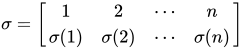
S n {\displaystyle S_{n}} 嘅嘢係咁嘅樣 σ = [ 1 2 ⋯ n σ ( 1 ) σ ( 2 ) ⋯ σ ( n ) ] {\displaystyle \sigma ={\begin{bmatrix}1&2&\cdots &n\\\sigma (1)&\sigma (2)&\cdots &\sigma (n)\end{bmatrix}}} 。
對稱群有好多子群。例如: S 4 {\displaystyle S_{4}} 有 30 {\displaystyle 30} 個子群, S 5 {\displaystyle S_{5}} 就有超過 100 {\displaystyle 100} 個。
將正方形嘅四隻角用 { 1 , 2 , 3 , 4 } {\displaystyle \{1,2,3,4\}} 代表。將個正方形旋轉同反射組合咁佢就係一個四次嘅旋轉反射群, D 4 {\displaystyle D_{4}} 。
佢都係一類執位群:
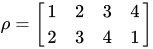
旋轉 90 ∘ {\displaystyle 90^{\circ }} 就係 ρ = [ 1 2 3 4 2 3 4 1 ] {\displaystyle \rho ={\begin{bmatrix}1&2&3&4\\2&3&4&1\end{bmatrix}}} ;
打橫反射就係 ϕ = [ 1 2 3 4 2 3 1 4 ] {\displaystyle \phi ={\begin{bmatrix}1&2&3&4\\2&3&1&4\end{bmatrix}}} 。
D 4 {\displaystyle D_{4}} 係 S 4 {\displaystyle S_{4}} 嘅子群。
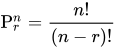
執位嘅方法總數係 P r n = n ! ( n − r ) ! {\displaystyle \operatorname {P} _{r}^{n}={\frac {n!}{(n-r)!}}}